Why the best CV in the pile often never gets read
Across five real job postings, the highest-scoring CV arrived in the second half of the pile three times — once at applicant 16 of 17, once at 11 of 12, once dead last at 10 of 10. Anyone who had read in the order the applications arrived and stopped when they had "enough good ones" would have missed the best candidate in three roles out of five.
This is a small sample and it comes from one company. Here is exactly what it is before we draw anything from it.
What we looked at
| Jobs | 5 — the real postings with five or more applicants |
|---|---|
| CVs | 77 real candidates |
| Companies | 1 client workspace |
| Period | 2–20 September 2026 |
| Order used | The order applications actually arrived |
Every CV was scored against the job description the applicant applied to, before anyone looked at it, so the ranking is not contaminated by what a recruiter thought first.
Where the best CV landed
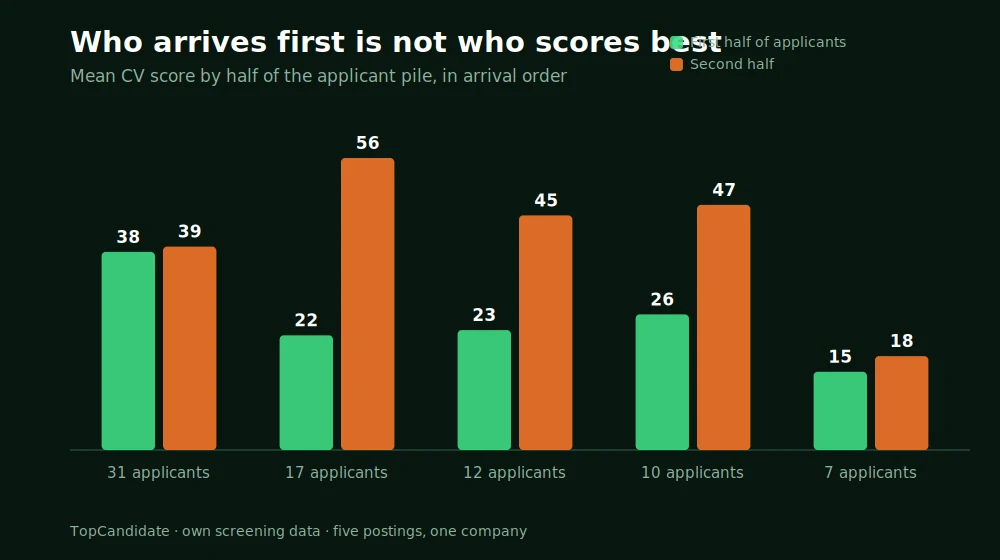
| Applicants | Best score | Arrived at | Mean, first half | Mean, second half |
|---|---|---|---|---|
| 31 | 66 | #4 | 38 | 39 |
| 17 | 77 | #16 | 22 | 56 |
| 12 | 64 | #11 | 23 | 45 |
| 10 | 54 | #10 | 26 | 47 |
| 7 | 38 | #2 | 15 | 18 |
The strongest CV in the entire set — 77 out of 100, the only one above 75 — was the sixteenth of seventeen applicants for its role.
What we cannot tell you
We cannot tell you why the later applicants scored higher, and we are not going to guess loudly.
A perfectly ordinary explanation is that the employer posted to a second channel partway through, and the second channel sent better-matched people. That would produce exactly this pattern and would have nothing to do with the order anyone read in. Another is chance: on twelve applicants, one strong CV late in the list is not remarkable.
That second claim does not need a mechanism. It is just what happened.
Why reading in order is the default anyway
Nobody decides to screen badly. The order effect comes from the process, not the person:
- Applications arrive as a queue. Email, job board inbox, a folder. The interface hands them to you oldest-first, so that is the order you read.
- Attention is not uniform. CV number 4 gets read properly. CV number 40 gets scanned. This is not a character flaw; it is what happens to anyone after an hour.
- "Enough good ones" is a real stopping rule. Once you have six people worth calling, the remaining thirty feel optional — and the incentive to keep reading disappears exactly when the pile is longest.
- Arriving early is rewarded twice. Early applicants get the freshest attention and get compared against an empty shortlist.
The stopping rule is not irrational, either. Reading is the most expensive part of hiring: at 500 applicants it costs about three working days, which is several times the price of the job posting. Anyone who stops early is responding to a real cost. They are just paying it in a different currency.
In the full set of 78 CVs we scored, the median was 38 out of 100 and only about a third reached 48. When most of a pile is weak, the few strong ones are exactly the ones a tiring reader is most likely to skim past.
What actually fixes it
Not "read more carefully". The fix is to remove the order:
- Score everything before anyone reads anything. Whatever you rank on — a rubric on paper works — apply it to all of them before opinions form.
- Read in ranked order, not arrival order. Then fatigue costs you the weakest CVs instead of a random slice.
- Set the stopping rule on the rank, not on the clock. "Everyone above the line" survives a long pile. "The first six who look good" does not.
- Keep the rest visible. People below your line should stay reachable, not be deleted at the end of the day.
This is the whole argument for screening software, and it is a narrower claim than the marketing usually makes. It is not that a machine judges people better than you do — there is a lot it cannot see. It is that it reads the four-hundredth CV with exactly the attention it gave the fourth, and then hands the decision back to you.
What would make this finding stronger
- More companies. Five postings at one employer is an observation, not a pattern.
- The source of each application. That would settle the "second channel" explanation in an afternoon, and we intend to log it.
- Outcomes. We know who scored well. We still do not know who was hired and stayed.
When we have those, we will publish them the same way — sample first, then the numbers, and we will say so if they disagree with this.
Questions we get asked
Does the order CVs arrive in affect who gets hired?
In our data it could have. Across five real postings the highest-scoring CV arrived in the second half three times, so a recruiter who stopped halfway would have missed the best candidate in three roles out of five.
Why do recruiters miss good CVs?
Not carelessness. Applications arrive as a queue, attention drops over an hour of reading, and "enough good ones" is a real stopping rule that bites hardest exactly when the pile is longest.
Read next
We scored 78 real CVs — only a third cleared the bar
Median score 38 out of 100, and 35% at 48 or above. The real distribution from 78 CVs across six jobs, with the sample stated plainly.
AI in hiringWhat AI screening can and cannot judge from a CV
Six dimensions, what each one reads, which actually separate candidates, and the three things no parser sees. With our own numbers.
AI in hiringWhy an AI should never reject anyone by itself
A CV score is evidence, not a decision. What an AI genuinely cannot see in a CV, and why a person should press the button.
Cost of hiringWhat it actually costs to hire one person in Bangladesh
Job posting prices, measured screening costs, and the one line item only you can price. A worked breakdown rather than a borrowed average.