We scored 78 real CVs — only a third cleared the bar
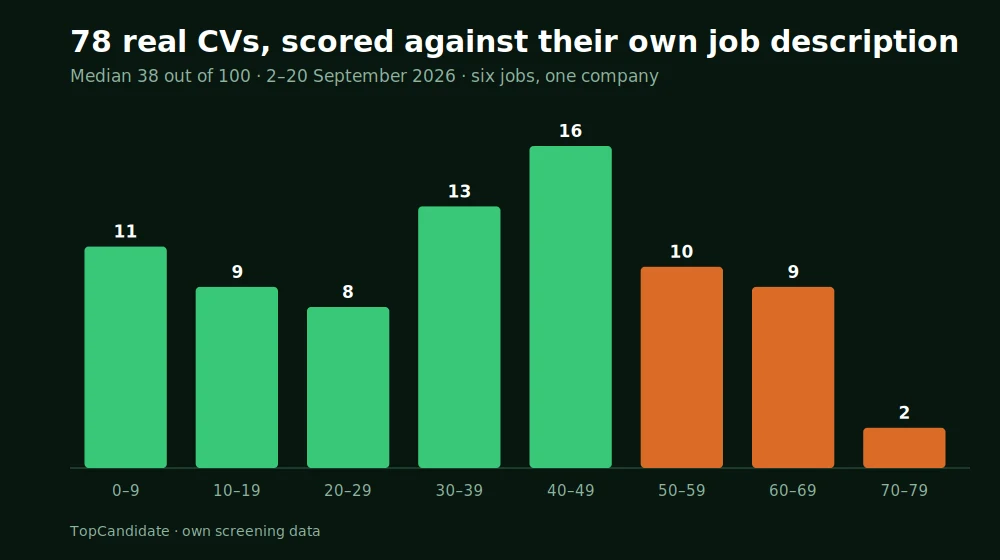
Across 78 real CVs, scored against the job description each person applied to, the median score was 38 out of 100. About a third — 35% — reached 48 or above, which is where most of our clients set their "worth a conversation" line. One CV in the whole set scored above 75.
Before anything else: this is a small sample, and it comes from one company. Here is exactly what it is, so you can decide how much weight it carries.
What the sample is
| CVs scored | 78 real candidates |
|---|---|
| Jobs | 6 — analyst, BI and sales roles |
| Companies | 1 client workspace |
| Period | 2–20 September 2026 |
| Excluded | every test record, fixture and CV we submitted ourselves |
Our database holds 365 screening rows in total. Most of those are our own tests. Stripping out test flags, fixtures, the quarantine workspace and CVs submitted under our own name leaves these 78. This is not an industry study. It is one company's September, and if the next client's roles are different the numbers will move.
The distribution
| Threshold | Reached it | Share |
|---|---|---|
| 48 or above | 27 of 78 | 35% |
| 60 or above | 11 of 78 | 14% |
| 65 or above | 6 of 78 | 8% |
| 75 or above | 1 of 78 | 1% |
The quartiles tell the same story: a quarter of CVs scored 19 or below, and a quarter scored 51 or above. The best CV in the set reached 77.
Why so many score low
The single clearest driver is skills coverage — how many of the requirements written in the job description actually appear anywhere in the CV.
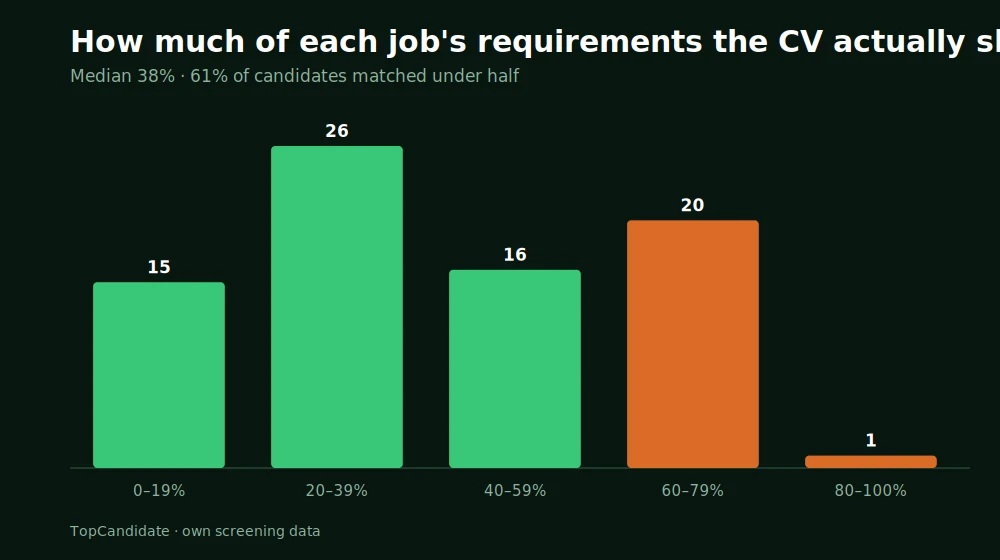
62% of these candidates matched under half of what the posting asked for. That is not 62% of people being unqualified. Some of it is genuine mismatch — people applying widely rather than carefully, which is rational when applying is free. Some of it is job descriptions listing nine tools when the work needs three. And some of it is CVs that describe duties rather than evidence, so the thing the person can actually do never appears in writing.
What a score of 38 means, and what it does not
It means: against this posting, on six weighted dimensions, this CV showed 38% of the way to a complete match, and every one of those points is traceable to a line in the document.
It does not mean the person is a bad hire. Our recommendation bands put 51 of the 78 in the lowest band — and we still show them all, in ranked order, with the gaps named. Nothing in the system rejects any of them. A person decides, and people regularly pull someone up from the middle of the list because they recognise the employer, or the gap is explainable, or the CV is badly written but the last role is exactly right.
What this changes about a cut-off
If you set your interview threshold at 48 on data like this, you are talking to roughly one applicant in three. At 60 it is one in seven. At 75 it is one in seventy-eight — you have written a posting almost nobody can satisfy, which is usually a sign that the requirements list is aspirational rather than real.
That is the practical use of a distribution like this: not to judge candidates, but to check whether your own bar matches the market you are hiring in. We saw thresholds set between 15 and 43 across these jobs, all well under our software's default of 48 — the recruiters, quite sensibly, adjusted to what they were seeing.
What we would need before claiming more
- More companies. One client's standards are one client's standards.
- More role types. These are analyst and sales roles. Nursing, teaching and factory supervision will not look like this.
- The outcome. We know who scored well. We do not yet know who got hired and stayed, which is the only number that finally matters.
When we have those, we will publish them the same way: sample first, then the numbers. If the second sample disagrees with this one, we will say so.
Read next
Why an AI should never reject anyone by itself
A CV score is evidence, not a decision. What an AI genuinely cannot see in a CV, and why a person should press the button.
High-volume screeningWhy the best CV in the pile often never gets read
In three of five real job postings the top-scoring CV arrived in the second half of the pile. What reading in arrival order actually costs.
AI in hiringWhat AI screening can and cannot judge from a CV
Six dimensions, what each one reads, which actually separate candidates, and the three things no parser sees. With our own numbers.
High-volume screeningWhy "we’ll only contact you if shortlisted" costs your employer brand
Our own close-out email has been used zero times: 47 of 56 candidates heard nothing. Why it happens, and what it costs.